

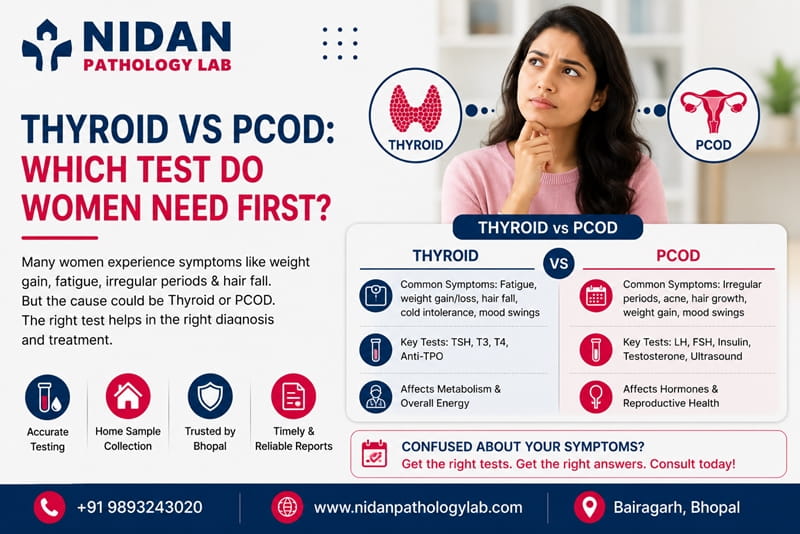
Thyroid vs PCOD: Which Test Do Women Need First?
If you are a woman experiencing irregular periods, weight gain, hair loss, acne, or tiredness — two conditions are usually the first suspects: thyroid disorder and PCOD (Polycystic Ovarian Disease, also called PCOS). Both are extremely common among women in Bhopal and across India, and they share many overlapping symptoms.
The most common question women ask is: should I get my thyroid tested first, or PCOD? This article will answer that question clearly, explain how the two conditions differ, and guide you on what tests to ask for.
What Is Thyroid Disease?
The thyroid gland produces hormones (T3 and T4) that regulate metabolism — how your body uses energy. When the thyroid is underactive (hypothyroidism), it produces too little hormone. When it is overactive (hyperthyroidism), it produces too much.
Hypothyroidism is far more common, especially in women. It is estimated that 1 in 8 women will develop a thyroid condition in her lifetime.
Common Symptoms of Hypothyroidism in Women
- Weight gain without changing diet
- Fatigue and low energy
- Hair thinning and hair loss
- Irregular or heavy periods
- Feeling cold all the time
- Depression and mood changes
- Dry skin and brittle nails
- Constipation
- Difficulty getting pregnant
What Is PCOD / PCOS?
PCOD (Polycystic Ovarian Disease) or PCOS (Polycystic Ovary Syndrome) is a hormonal imbalance that affects the ovaries. Women with PCOD have higher-than-normal levels of male hormones (androgens), which can disrupt the menstrual cycle and cause cysts on the ovaries.
PCOD is one of the most common hormonal disorders in women of reproductive age, affecting up to 15–20% of Indian women.
Common Symptoms of PCOD in Women
- Irregular or absent periods
- Weight gain — especially around the belly
- Excessive hair growth on face, chest, or back (hirsutism)
- Acne and oily skin
- Hair loss or thinning from the scalp
- Difficulty getting pregnant
- Dark patches on skin (acanthosis nigricans)
- Mood swings and anxiety
Thyroid vs PCOD — What Is the Difference?
Both conditions share several symptoms — irregular periods, weight gain, hair loss, fatigue, and difficulty with fertility. However, there are key differences:
- Thyroid is caused by the thyroid gland not functioning correctly
- PCOD is caused by a hormonal imbalance involving the ovaries and androgens
- Thyroid affects both men and women; PCOD only affects women
- Hirsutism (excessive hair on face/body) is a PCOD symptom, not thyroid
- Feeling very cold is a thyroid symptom, not usually PCOD
- Acne is more commonly a PCOD symptom
Importantly — a woman can have both thyroid disease AND PCOD at the same time. Studies show that up to 20–30% of women with PCOD also have thyroid abnormalities. This is why testing for both is often recommended.
Which Test Should You Get First?
The short answer: get both tested together. Here is why:
A TSH (thyroid test) is a simple, affordable, and fast test. A hormonal panel for PCOD may include LH, FSH, testosterone, prolactin, and AMH — a larger set of tests. However, because the symptoms overlap so much, doctors in Bhopal usually recommend testing for thyroid first, as thyroid disorders are more common and easier to treat. If thyroid results are normal, PCOD testing follows.
If you are experiencing irregular periods, weight gain, and infertility — ask your doctor for a comprehensive panel that includes both thyroid and PCOD markers together.
Blood Tests for Thyroid
- TSH (Thyroid Stimulating Hormone) — First-line test
- Free T3 and Free T4 — If TSH is abnormal
- Anti-TPO Antibodies — To check for Hashimoto’s (autoimmune thyroid disease)
Blood Tests for PCOD
- LH (Luteinizing Hormone) — Usually elevated in PCOD
- FSH (Follicle Stimulating Hormone) — LH:FSH ratio is a key diagnostic marker
- Testosterone — Elevated androgens confirm PCOD
- Prolactin — To rule out other hormonal conditions
- AMH (Anti-Mullerian Hormone) — Reflects ovarian reserve and follicle count
- Fasting Insulin and Fasting Blood Sugar — PCOD causes insulin resistance
- Ultrasound — Not a blood test, but needed to confirm multiple cysts on ovaries
Can PCOD Cause Thyroid Problems — and Vice Versa?
Yes. PCOD causes insulin resistance and metabolic changes that can affect the pituitary gland and thyroid hormone production. Similarly, hypothyroidism affects the production of sex hormones, which can worsen PCOD symptoms. The two conditions are closely linked and often co-exist.
This is why managing one condition properly often helps improve the other as well.
How Are Thyroid Disorder and PCOD Treated?
Thyroid Treatment
Hypothyroidism is treated with levothyroxine (a synthetic thyroid hormone) taken daily. With proper medication and regular monitoring, most women achieve normal thyroid levels and symptom relief within weeks.
PCOD Treatment
PCOD management includes lifestyle changes (weight loss, diet, exercise), medications to regulate periods (oral contraceptive pills), anti-androgen drugs for excess hair, and metformin for insulin resistance. Fertility treatments are available for women trying to conceive.
Women’s Hormonal Testing at Nidan Pathology Lab Bhopal
Nidan Pathology Lab in Bairagarh, Bhopal offers comprehensive women’s hormonal testing panels that include both thyroid and PCOD markers. You can get all the required tests done in a single visit or opt for home blood sample collection.
Our lab processes TSH, T3, T4, LH, FSH, prolactin, testosterone, AMH, and insulin fasting tests — everything needed for a complete hormonal evaluation. Reports are fast, accurate, and delivered to your WhatsApp.
Conclusion
Both thyroid disorder and PCOD are very manageable conditions — but they need to be diagnosed correctly first. If you are experiencing irregular periods, weight gain, hair loss, or difficulty conceiving, do not self-diagnose or self-medicate. Get tested. The right diagnosis leads to the right treatment.
Book your thyroid or PCOD test at Nidan Pathology Lab in Bhopal today. Call +91 9893243020 or visit nidanpathologylab.com. Your hormones deserve attention.
Nidan Pathology Lab, Bairagarh, Bhopal | +91 9893243020 | nidanpathologylab.com