

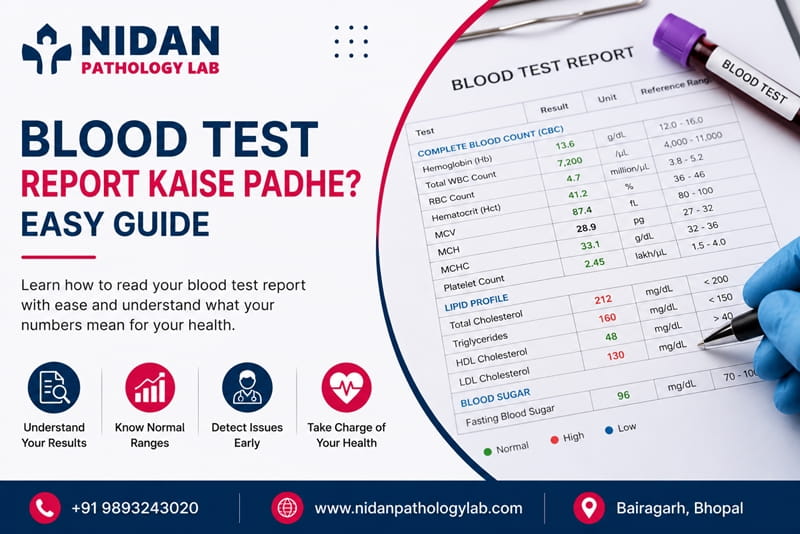
Blood Test Report Kaise Padhe? A Simple and Easy Guide
You have collected your blood test report from the lab, and now you are staring at a page full of numbers, abbreviations, and ranges — and you have no idea what any of it means. Sound familiar? You are not alone.
Most people in Bhopal and across India feel confused when they look at their blood test reports. This guide will teach you how to read and understand a blood test report step by step, in simple language that everyone can follow.
Why Reading Your Report Matters
While your doctor will always explain your report to you, knowing how to read a blood test report yourself gives you power. You can monitor your own health over time, ask better questions during consultations, and understand why certain treatments are being recommended for you.
This guide covers the most common blood tests done at Nidan Pathology Lab in Bhopal — CBC, Blood Sugar, Thyroid, and Lipid Profile.
Understanding the Basic Structure of a Blood Report
Every blood test report has the following sections:
- Test Name: The name of what was measured (e.g., Hemoglobin, TSH, Glucose)
- Your Result: The actual value measured from your blood sample
- Reference Range / Normal Range: The range considered healthy for most adults
- Unit: The measurement unit used (g/dL, mg/dL, mIU/L, etc.)
- Status: Some labs mark results as High (H), Low (L), or Normal (N)
If your result is within the reference range, it is generally considered normal. If it is outside — either above or below — your doctor will decide if treatment is needed based on your symptoms and history.
How to Read a CBC (Complete Blood Count) Report
CBC is the most common blood test. Here is how to read the key values:
Hemoglobin (Hb)
Normal: Men 13.5–17.5 g/dL | Women 12–15.5 g/dL. Low hemoglobin means anemia — you may feel tired or breathless. High hemoglobin can mean dehydration or a blood disorder.
WBC (White Blood Cell Count)
Normal: 4,000–11,000 cells/mcL. High WBC usually means an infection. Very high WBC can sometimes indicate blood cancers. Low WBC may indicate a weakened immune system.
Platelets (PLT)
Normal: 1.5 to 4.5 Lakhs per microliter. Low platelets (below 1 lakh) can be dangerous and is a key sign of dengue fever. High platelets can indicate iron deficiency or inflammation.
RBC Count
Normal: Men 4.5–5.9 million/mcL | Women 4–5.2 million/mcL. Low RBC supports a diagnosis of anemia. High RBC can mean dehydration or polycythemia.
How to Read a Blood Sugar Test Report
Blood sugar can be tested in several ways. Here is how to read the common ones:
Fasting Blood Glucose
This test is done after 8–10 hours of fasting (no food or drinks except water).
- Normal: 70–100 mg/dL
- Pre-diabetes: 100–125 mg/dL
- Diabetes: 126 mg/dL or above (if confirmed on two separate tests)
Post-Meal Blood Sugar (Postprandial)
This test is done 2 hours after eating a meal.
- Normal: Below 140 mg/dL
- Pre-diabetes: 140–199 mg/dL
- Diabetes: 200 mg/dL or above
HbA1c
This shows your average blood sugar over the last 3 months.
- Normal: Below 5.7%
- Pre-diabetes: 5.7%–6.4%
- Diabetes: 6.5% or above
How to Read a Thyroid Test Report
The most important value in a thyroid report is TSH:
- Normal TSH: 0.4 to 4.0 mIU/L
- High TSH (above 4.0): Hypothyroidism — thyroid is underactive
- Low TSH (below 0.4): Hyperthyroidism — thyroid is overactive
T3 and T4 values give more detail. Your doctor may order all three to get a complete picture of your thyroid health.
How to Read a Lipid Profile Report
A lipid profile measures cholesterol and fats in your blood. Here are the key values:
- Total Cholesterol: Desirable below 200 mg/dL | Borderline High: 200–239 | High: 240 and above
- LDL (Bad Cholesterol): Optimal below 100 mg/dL | High risk: 160 and above
- HDL (Good Cholesterol): Low risk: above 60 mg/dL | Low HDL is a risk factor
- Triglycerides: Normal below 150 mg/dL | High: 200 and above
Common Abbreviations on Blood Reports
- Hb or Hgb: Hemoglobin
- WBC: White Blood Cells (also called Leukocytes)
- RBC: Red Blood Cells (also called Erythrocytes)
- PLT: Platelets
- MCV: Mean Corpuscular Volume (size of red blood cells)
- MCH: Mean Corpuscular Hemoglobin (amount of hemoglobin per cell)
- MCHC: Mean Corpuscular Hemoglobin Concentration
- TSH: Thyroid Stimulating Hormone
- FBS: Fasting Blood Sugar
- PPBS: Post Prandial Blood Sugar (post-meal)
- HbA1c: Glycated Hemoglobin (3-month average sugar)
- LDL: Low-Density Lipoprotein (bad cholesterol)
- HDL: High-Density Lipoprotein (good cholesterol)
- TG: Triglycerides
Important Things to Remember
- Never self-diagnose based only on your report. Always consult your doctor.
- One abnormal value does not mean disease. Context and symptoms matter.
- Reference ranges may differ slightly between labs — compare only within the same report.
- Some values can change based on time of day, fasting status, or medications.
- Keep all your old reports to track changes over time.
Get Your Blood Tests Done at Nidan Pathology Lab Bhopal
Nidan Pathology Lab in Bairagarh, Bhopal provides accurate blood testing with easy-to-read digital reports. All reports are shared on WhatsApp with proper reference ranges so you can understand your results easily.
Our trained technicians ensure precise sample collection, and our modern lab equipment delivers reliable results every time. We also provide expert guidance to help you understand your reports if needed.
Frequently Asked Questions (FAQs)
Q:1 Blood Test Report में ‘Reference Range’ का क्या मतलब होता है?
Reference Range (या Normal Value) वह पैमाना है जिसके भीतर एक स्वस्थ व्यक्ति के टेस्ट रिजल्ट्स होने चाहिए। अगर आपकी वैल्यू इस रेंज से कम या ज्यादा है, तो यह किसी स्वास्थ्य असंतुलन का संकेत हो सकता है।
Q:2 CBC (Complete Blood Count) टेस्ट रिपोर्ट में क्या-क्या देखा जाता है?
CBC टेस्ट में मुख्य रूप से Hemoglobin (Hb), Red Blood Cells (RBC), White Blood Cells (WBC/TLC), Lymphocytes/Neutrophils (DLC), और Platelets की संख्या जांची जाती है जो इन्फेक्शन या एनीमिया का पता लगाती है।
Q:3 क्या ब्लड रिपोर्ट खुद देखकर इलाज शुरू किया जा सकता है?
बिल्कुल नहीं। यह गाइड सिर्फ रिपोर्ट को समझने के लिए है। किसी भी असामान्य (High/Low) वैल्यू के आने पर तुरंत डॉक्टर से परामर्श लें और उनके निर्देशानुसार ही उपचार शुरू करें।
Conclusion
Reading your blood test report does not have to be overwhelming. By understanding the basic structure of the report, knowing the normal ranges for common tests, and learning what key abbreviations mean, you can become an informed patient.
Remember, your report is a guide — not a verdict. Always work with your doctor to understand what the numbers mean for your specific health situation. And for accurate, affordable blood tests in Bhopal, contact Nidan Pathology Lab at +91 9893243020.
Nidan Pathology Lab, Bairagarh, Bhopal | +91 9893243020 | nidanpathologylab.com